Feb 3, 2006

Movie advert 2

Polish Student Alliance
in Pittsburgh, PA

invites you to the
2nd POLISH MOVIE NIGHT
(free)
Movie of the week
: Rejs

When? February 9th (Thursday) 7:30PM-9:00PM

Where? 4130 Posvar Hall (University of Pittsburgh)


Movie genre: Comedy

Year: 1970 Duration: 1 hour, 0 minutes Other: Black&white, Polish with English subtitles
Directed by Marek Piwowski. Starring Stanislaw Tym.

Rejs (The Cruise) is the mother of all cult films in Polish cinematography. Shot in a quasi-documentary style, with a cast featuring few professional actors, it is a perfect parody of the People's Republic of Poland, reducing a weekend river cruise to a hilarious parody of the entire communist system.

A stowaway (Stanisław Tym) sneaks aboard a ship departing on a cruise down the Vistula River. The captain takes him for a Communist Party cultural coordinator (KO) and the intruder gladly adapts to his new role, immediately setting to work at manipulating the passengers and crew into silly and vaguely humiliating games. Before long, Tym has got everyone under his thumb and created his own comedic dictatorship.


To be followed:

February 23 (Ogniem i Mieczem, Part 1 of 2) (1999)

March 16 (Ogniem i Mieczem, Part 2 of 2) (1999)

Room opens at 7:00 p.m, so if you want to practice your Polish, feel free to arrive early and talk with us!


TTags:

Singularity update

From epaper to hibernation, new breakthroughs are paving the way towards the Singularity. This amusing piece about Google future may not be that far from reality, actually...


TTags:

Jan 30, 2006

Wikipedia vs US Congress

Wikipedia does not tolerante 'vandalism' or 'POV pushing', no matter where it comes from. Apparently, some people with IP address tracing back to US Congress have been engaging in just that - and it has gotten serious enough for Wikipedia community to implement one of the middle steps of the dispute resolution process, known as the Request for Comments. Earlier steps include normal taking and mediation, and the only step left after failed RfC (which is not binding) is the binding ruling by Wikipedia Arbitrators (during the process known as Request for Arbitration).

From Wikipedia page:
I am opening this RFC in order to centralise discussion concerning actions to be taken against US Congressional staffers who repeatedly engage in revert wars, blank content, engage in libelous behaviour or violate WP:NPOV, WP:CIV. The editors from these IP ranges are rude and abrasive, immature, and show no understanding of Wikipedia policy. The editors also frequently try to whitewash the actions of certain politicians. They treat Wikipedia articles about politicians as though they own the articles, replacing community articles with their own sanctioned biographies and engaging in revert wars when other users dispute this sudden change. They also violate Wikipedia:Verifiability, by deleting verified reports, while adding flattering things about members of Congress that are unverified.

The editors are currently blocked, but only for a week, so I feel this RFC is needed for the community to comment. I feel that a 1 week block is not enough.

It will be interesting to see if mainstream media picks that up.

Update: It did. Most of the Google News: Wikipedia stories are about this (note: link relevancy subject to change in few days).
See also this Wikinews story.

TTags: ,

Jan 20, 2006

Wiki news: the Tron chapter

It figures. I get a little bit behind on current happenings, and an interesting story has to pass me by :)

German Wikipedia was shut down for a few days by German court: big thumbs down for Germany, apparently joining China in an attempt to silence the reality (if only for a three days). Although it's nice to see that the judges had enough wit to lift the shut down orders, it should have never been issued in the first place. Let's hope this never again happens: imagine if just suing about some detail could couse a Wiki to be shut down.

If the parents of the deceased hacker 'Tron' wanted to keep the low-down status, they should've known better then to go against Wikipedia. The English wiki was never affected, as it is not a subject to any German verdict anyway, and the news buzz (and blog buzz) generated by their actions surely will have an opposite effect to what they wanted. For other interesting indicators, note that the page did not even exist on en-wiki before the shut down of de-wiki.

Wikipedia Signpost has it's own story on that, of course. Note it already has cost us at least 500 euro to deal with this... well, legal vandlism, I guess. It's really annoying to see that money donated by people of good will around the world has to be spent on such trivial issues. Update: as has been pointed out in the comments (tnx!), the 500 euro is a bail amount, thus refundable. Other costs are presently unknown AFAICT.

Conclusion: if you want to gain fame, try to be anonymous by acting as the elephant in the porcelain shop (that's a Polish proverb, btw).

On a related note, I wish I could read German.

Also, Wikipedia Signpost has an interestign article on constructive reactions to being slandered on Wiki.


TTags: , , ,

Wikibook special: the Lessig edition

I've learned recently that Lawrence Lessig, the Creative Commons champion, is engaging in yet another experiment: he is working on an update of his book (Code and Other Laws of Cyberspace), but instead of doing it alone - he has created a wiki (Code V.2) to recruit helpers.

A great idea, if anybody wants my opinion :)

TTags: , , ,

Movie advert

Polish Student Alliance
in Pittsburgh, PA

invites you to the
POLISH MOVIE NIGHT
(free)
Movie of the week
: Seksmisja

When? January 26th 7:30PM-9:30PM

Where? 4130 Posvar Hall


Movie genre: Sci-fi, comedy

Year: 1984 Duration: 2 hours, 0 minutes Other: Color, Polish with English subtitles
Directed by Juliusz Machulski Starring Jerzy Stuhr, Olgierd Łukaszewicz, Beata Tyszkiewicz

A cult Polish production
The two main characters, Maks and Albert, played by Jerzy Stuhr and Olgierd Łukasiewicz, respectively, submit themselves to the first human hibernation experiment. Instead of being awakened after a few years, they wake up in the 21st century, in a post-nuclear world, where all humans have retreated to underground living facilities, and, what's most important, where men had died out as a result of subjection to a specific kind of radiation.


To be followed:

February 9 Rejs (1970)
February 23 (Ogniem i Mieczem, Part 1 of 2) (1999)

March 16 (Ogniem i Mieczem, Part 2 of 2) (1999)

Room opens at 7:00 p.m, so if you want to practice your Polish, feel free to arrive early and talk with us!


TTags:

Jan 19, 2006

Mozilla/Firefix Wallpapers

A really interesting wallpapers for Mozilla/Firefox can be found here.

Mozilla socrealism... ingenious :)


TTags: , ,

Jan 17, 2006

The AMV War

According to Lessig, the copyright hounds may be preparing for a new war, and their target are AMV (anime music videos). Lessig is optimistic that we will win - I hope so. Kudos to the AMV community, and to their defenders!


And if you haven't seen some, what are you still waiting for?


On a related note, reading Lessig's article on AMVs in FT I found this staggering sstatistic: According to a recent Pew study, almost 60 per cent of US teenagers have created and shared content on the internet. Now, in an excellent class I attended last term (Digital Governance, University of Pittsburgh, dr Stuart Shulman) I learned that only 4% of net users actually contribute the content. But if 60% of the new generation do it... can you imagine the consequences?

It will be BIG. And my mood just got much better :)

TTags: , , , , , ,

Jan 16, 2006

The forgotten controvercies of Freud

I find it interesting, when assigned a reading by some academic (past or present), to read his biography. Much of one's work can be better understood in the context of one's experiences. And who'd be better for such analysis then the father of psychoanalysis, Sigmund Freud?

He is a much more interesting persona then I'd have thought. In the spirit of the early scientists, he experimented on himself - trying to come to grips with his own phobias. A compulsory smoker - he smoked a box of 30 cigarettes per day (!), an early user and proponent of cocaine as a stimulant, he destroyed his personal papers and notes at least twice. Additionally, his later papers were closely guarded in the Sigmund Freud Archives, access to which was restricted and spawned at least one controversy. Last but not least, his death was a suicide (via euthanasia due to cancer pain, to be precise).

We often look at Freud as the 'shrink', forgetting he was a prominent social theorist - sociologist - as well. After reviewing his various works I do have to say I find his approach to civilization and religion perhaps the most intriguing of his life's works. In Civilization and Its Discontents he presents a fairly pessimitsic, bleak view of our civilization: that by attempting to solve problems (lack of food, security) civilization forces us into unnatural behaviour (family, law) which thus results in mental sickness (neurosis and such). Religion, according to him, is similar to Marx 'opium for the masses. In the The Future of an Illusion he critizes ogranized religion as actually being a 'collective neurosis', arguings that religion has tamed asocial instincts and created a sense of community around a shared set of beliefs, thus helping the civilization, yet at the same time it has also exacted an enormous psychological cost to the individual by making him perpetually subordinate to the primal father figure embodied by God. Finally, in one of his last books, Moses and Monotheism, he deconstructs the Bible using his theories, arguing that Moses only led his close followers into freedom, and that they subsequently killed Moses in rebellion either to his strong faith or to circumcision. Freud explains that years after the murder of Moses the rebels formed a religion which promoted Moses as the Saviour of the Israelites. Freud said that the guilt from the murder of Moses is inherited through the generations; this guilt then drives us to religion to make us feel better.

TTags: ,

Jan 14, 2006

This and that

First a warp drive, now some phasers :) This, at least, was more to be expected.

For a government run near-monopoly, BBC is suprisingly innovative and user friendly: check out their new RSS feed initative.

TTags: , ,

Jan 11, 2006

Wiki-news

An interesting article: Isreali journalist comes to grip with Wikipedia. It's a nice, subjective - but fair - read. "Wikipedia is going to be around for yet another day." Yep :)

Chineese want their Wiki dose. "Chinese students and intellectuals are expressing outrage at Beijing's decision to prohibit access to Wikipedia, the fast-growing on-line encyclopedia that has become a basic resource for many in China." Good for them, let's hope they win.

Wikipedia itself, in the meantime, is electing it's judges. Yes, we have judges, lawyers, police... :)


TTags: , , ,

Jan 10, 2006

Understanding new generation

Social networking seems to be catching on - yet another exponential trend? Definetly something to be aware of if you are involved in university - no matter whether you are a student, lecturer, TA...


TTags:

Jan 7, 2006

That came sooner then I expected...

KurzewilAI.net newsflash: A "hyperspace" engine that could make interstellar space travel a reality by flying into other dimensions is being investigated by the United States Air Force and Department of Energy.

TTags:

Jan 5, 2006

Free Hacking Matter

A nice book about nanotechnology and programmable matter has been released as a free pdf. Enjoy - but beware of criticisms.

Also - check out this gadget - is the electronic paper newspaper here at last?

Jan 3, 2006

Newsflash

World Economic Forum Participants to Blog - that should be an interesting read

BusinessWeek speaks out against patents - let's hope somebody listens

P2P party - go Sweden, I'd vote for them :) This actually deserves a longer post, but I am tired and sick today, so just a thought: in the coming era of e-democracy, politicians (and parties) will increasingly concentrate on single matters, as they realize people don't have time to read long party manifestos, or go back and check how many of 1001 promises were kept. Logically this should lead to some politicians submitting every single of their desision to a vote of his electorate and voting as the majority wishes...

Jan 1, 2006

Firefox endorsment by Economist

Bit of an old news - Dec 14th 2005 - but an interesting article in The Economist nonetheless.

Tommorow I am flying back to US. Will blog soon :)

Dec 30, 2005

Fight for the future!

I have just become an CC innovator. It feels good... especially considering I payed for it with the money I earned :)


Become a Creative Commoner today, and help protect our culture and future!

Dec 28, 2005

Vive l'Australia? :)

Lessig and Slashdot report that Austrialia may join France in legalizing p2p sharing. I like Lessig's blog post: 'Sanity breaking out all over' :) Slashdot report is here.

Dec 22, 2005

Vive la France!

Wow. They did impress me: the French Parliament voted yesterday for a lawl that allows free sharing of music and movies over the internet. In exchange, all copyright owners will receive a subsidy from a tax paid by Internet users. This sounds like a great idea, similar to what Lessig suggested in his Free Culture book. I'd just make sure that the technicalities are workable, i.e. that the tax is heavier on those with unlimited broadboand. I wouldn't mind paying an additional dozen or so bucks for my Internet if this would finally solve all the p2p problems (and after all, the artists do deserve to get paid, one way or another).

Dec 20, 2005

MicroPersuaded

Wow. The Micro Persuasion blog offers lots of great tips and tricks about getting the full potential out of various websites or technologies. If it can teach me some useful tricks about Wiki, then it can teach your proverbial grandma how to, well, do whatever she thinks she already knows :)

Subbed with Bloglines :)

I am off to Poland!

Dec 11, 2005

The force for evil

The Economist once described the Wikipedia as 'the force for good'. Of course, where there is good, there must be evil - spawned from greed, malice or simple lack of understanding. See the dark forces gathering here. Even if this article is right and Wiki is safe, the court proceedings will still cost money - money which comes from our donations and should be used on improving the encyclopedia, not feeding the lawyers :(

Update: ZDNet has a good article on this.
See also Wikipedia take on this.

Update2: Wikipedia defends itself with transparency, Register vs Wiki

Dec 6, 2005

Limits of good faith

"Today, as an experiment, we will be turning off new pages creation for
anonymous users in the English Wikipedia." - Jimbo Wales announcement

Sounds like a good plan. Deleting crap pages is much more difficult then
crap content in an otherwise worty artucle. It should be logical then that
to creat crap pages you should go to a little more trouble then with crap
content.

The naivety of some people at Wikipedia:Articles_for_creation is really...
something. Why people cannot read the rules? Or verify their spelling? Oh well.
The fact that a significant proportion of not-created entries is redirects due to
wrong spelling or copyvio is a proof that the restriction was wise. As for the rest,
people are posting their content/sources at this page, so others who decide to register
can actually create them.

Nov 28, 2005

Working Privateer remake!

Ah, I can't believe it. Finally. After years of waiting. A working Privateer remake.

See it here.


I am officially in heaven. The world if a perfect place...

For more info, see Wiki on Vegastrike.

Nov 25, 2005

Science only for the elite?

Following this Slashdot story, I arrived at a very interesting article in Guardian (British newspaper).

British Royal Society - or rather academic publishing industry pulling the strings - apparently is scared of the Internet. While they declare that "Funders should remember that the primary aims should be to improve the exchange of knowledge between researchers and wider society" in the same breath they state "We think it conceivable that the journals in some disciplines might suffer. Why would you pay to subscribe to a journal if the papers appear free of charge?".

Why? Wake up. Why should I pay for it, in the first place?

First of all, scientists publish their papers for prestige (fame) first, to get their data to the scientific community second, and for presonal profit a distant third. They get majority of their money in form of wages and/or grants. I have never heard of scientists making big bucks (or any bucks, actually) from their article publications. It's the journal publishers who are profiting, not the authors, and definetly not the public. Paying for a journal made perfect sence in the print and paper media. Now, with online publishing, wikis, blogs and such, the entire technical team can be reduced to one webdesigner (and considering that most of scientific journals have less then 1 editon per month, he can be working part-time). Money saved from publishers greedy hands can be used either to make content cheaper and more accessible to everybody, or to pay the author or the reviewrs/editors (who again very rarely get paid for their work).

Second, isn't science supposed to serve humanity? Barricading itself offline, and charging stiiff prices for your knowledge is not really ethical, yoi know. If you are not affiliated with a university (a Western one, preferably) - you need to pay from 5$ to several times that much for an equivalent of several pages. So if you really want to 'improve communication between scientists and the wider society', stop charging for your articles - especially since the primary contributors don't care either way.

Still, the Royal Society seems not to care: "While some companies do appear to be making excessive profits from the publication of researchers' papers, this should not be the primary factor guiding future developments in the exchange of knowledge between researchers." Pretty, isn't it?

Sure, some business model is needed - but there are many choices 'to have the cake' and 'eat it', as long as you don't think of publishing a journal as a profit enterpise. Live from donations. Use volunteers and trainees. Ask for grants/financial support from the state, related industries or universities. Charge universities for access - but don't charge private users.

I see no problem at all with in the scientific industry moving to free content. In such a move, everbody wins - well, everybody except the publishers. They were needed and did their job before the advent of the net. Now it is time to thank them for their job and tell them goodbye. From a useful tool they have become a parasitic relic of the past - and the sooner academic publishing realises it, the better for all of us.

Let's hope Royal Society stops looking into the past and does something more useful then trying to see who if Einstein is more popular then Newton (and they call this 'science'? sheez). Definetly not a proud day for the Royal Society.

For more info, see developing Google News stories on this subject.

Long live open access! Just watch out for the FUTON bias :)

Nov 22, 2005

Reminder

Station annoucement:

I am blogging a significant amount of stuff at my Flog Blog, and I will likely keep this dual blogging for a month. I think quite a few of my posts there contain useful computer fluency tips and tricks - so if you miss that part of my Voice, I just want to tell you it has been temporarily (since September) moved there.

End of annoucement.

Nov 21, 2005

Did I tell you I plan to live forever?

I don't want to achieve immortality through my work. I want to achieve it through not dying. - Woody Allen

In the news (through KurzewilAI.net):

Geneticists claim ageing breakthrough but immortality will have to wait

The Guardian, November 18, 2005

A genetic experiment to unlock the secrets of the aging process has created organisms that live six times their usual lifespan, raising hopes that it might be possible to slow aging in humans.

In the experiment, Valter Longo, a biomedical gerontologist at the University of Southern California and his team knocked out two key genes, named Sir2 and SCH9, in yeast cells.

SCH9 governs the cells' ability to convert nutrients into energy. The researchers believe that the Sir2 gene normally plays a role in restricting an organism's lifespan, and allows energy from the food it eats to be directed into growth and reproduction. By blocking the gene, the cells were essentially tricked into believing food was scarce and switched them into a survival mode.


Read Original Article>>

Nov 20, 2005

Flurry of Wikipedia evaluations

Apprently, a new meme has appeared among journalists: check this recent story in Wikipedia Signpost.

CNET review hit the proverbial bull in the eyes: "Wikipedia offers rich, frequently updated information, but you might need to verify some of its facts."

Check other stories at

Nov 19, 2005

The Truman Show?

I hope we are not going to cross that limit and make The Truman Show* a reality.

Check out this story.

* which is, btw, a very good movie

Nov 8, 2005

Is the glass half-empty – or half-full?

Frankfurt school represents a fairly broad series of views, ranging from the pessimism of Theodor Adorno through the balancing ideas of Herbert Marcuse to the optimism of Jürgen Habermas. As such, I find myself torn between the disagreement with some of its thinkers (like Adorno) and my support for others (like Habermas). Therefore I decided to look at some of the issues raised in their works, attempting to show you some real-life examples, that – in my view – make or break their points.

Adorno makes the case that technology prevents the class conflict by saturating the masses with goods (p.130) yet those goods are only material, not intellectual. I will counter him with another Frankfurtianist - Walter Benjamin, who views the technology as the tool bringing arts to the masses.Yes, standarization of culture is strong, but at the same time independent forces are getting stronger then ever – look, for example, at the distribution of independent movies through the Internet (visit onedotzero or iFilm), or consider how the idependent music challenging established brands (artists saying 'we don't want to pay you crippling royalties, we will sell our music online, and here, we are all equal).

Adorno and his fellow pessimists state that late capitalism represents the subordination of reason to industry commerce and profit market. I do actually agree with this – watching The Corporation should be enough to convince anybody – but the realization that globalization and capitalism are not perfect should not really be shocking. Homo sapiens is not a creature of perfection, but have we really sacrificed justice? I don't think so – if we did, we would have never created such an organization as the International Criminal Court. Equality? Equal rights is a fairly modern concept, if I am not mistaken? Loss of imagination? Tell that to the role-playing gamers, struggling with the accusations that they live in the world of imagination. Tolerance? I haven't heard of any religious wars or stake burnings lately - have you? The world is coming to an end? Uh – too far, they have not been saying that, did they? Still - scaremongering, I say to most such concepts. Although considering that most of those are basically a minority (off mainstream culture) pastimes, I can see why Herbert Marcuse argues that the potential of change lies with the outcasts.

Finally, we reach Harbermas. His ideas do tie nicely with the critique of the more pessimistic Frankrurtians. In his writings about the public sphere he aims to overcome the pessimism of his predecessors, but not abandoning it (a healthy dose of pessimism is always good, I say). Thus he makes a very good point that the mass society, with its institutions like the political parties undermine the quality of discourse and weaken the public sphere. But there is hope: this is why classical media is becoming a dinosaur threatened by the blogs, and blogosphere for many Internet-users is becoming a proffered source of information.(if you haven't, I strongly encourage you to visit the famous blogs like andrewsullivan.com, politics1.com or Daily Kos). Similarly, the political parties are under attack from non-partisan information-dissemination sites like Project Vote Smart. Habermas writes much about such discourse online, seeing in those tools the ideal way to reach the social consensus.

All things considered, I think that Frankfurt school offers a very wide range of frameworks we can chose to look at the reality surrounding us. I have chosen mine – and I look forward to hearing yours.

Oct 31, 2005

Political parties, Part 1

Bah. Confused my blogs. This entry moved to Flog of the Prokonsul. Feel free to read if you are interested in my thoughs on an academic paper about edemocracy and political parties.

10 top trends

KurzweilAI.net reports:


Wired News, Oct. 25, 2005

Mobile socialization, disruptive technology in the hybrid car market, growing demand for information-sensing devices that can reduce energy consumption, and an IT revolution in 2006 are among the forecasts by futurists.


Read Original Article>>

Will comment on the article when I have time to read it in few hours :)

Oct 28, 2005

Oct 22, 2005

Return of the Proconsul

Finally I found an English translation of my favourite poem, 'Powrót Prokonsula' by Zbigniew Herbert. So, without further due, here it goes:


The Return of the Proconsul

I've decided to return to the emperor's court
once more I shall see if it's possible to live there
I could stay here in this remote province
under the full sweet leaves of the sycamore
and the gentle rule of sickly nepotists

when I return I don't intend to commend myself
I shall applaud in measured portions
smile in ounces frown discreetly
for that they will not give me a golden chain
this iron one will suffice

I've decided to return tomorrow or the day after
I cannot live among vineyards nothing here is mine
trees have no roots houses no foundations the rain is glassy flowers smell of wax
a dry cloud rattles against the empty sky
so I shall return tomorrow or the day after in any case I shall return

I must come to terms with my face again
with my lower lip so it knows how to curb scorn
with my eyes so they remain ideally empty
and with that miserable chin the hare of my face
which trembles when the chief of guards walks in

of one thing I am sure I will not drink wine with him
when he brings his goblet nearer I will lower my eyes
and pretend I'm picking bits of food from between my teeth
besides the emperor likes courage of convictions
to a certain extent to a certain reasonable extent
he is after all a man like everyone else
and already tired by all those tricks with poison
he cannot drink his fill incessant chess
this left cup is for Drusus from the right one pretend to sip
then drink only water never lose sight of Tacitus
take a walk in the garden and return when the corpse has
been removed

I've decided to return to the emperor's court yes I hope that things will work out somehow

Oct 18, 2005

They own you!

A new study shows that 20 percent of human genes have been patented in the United States, primarily by private firms and universities (full story).

I don't know about you, but *this* has me worried. It's high time we revised our patent laws.
When The Economist, whom none can accuse of anti-capitalist bias, writes: It is becoming ever more apparent that the patent system isn't working (The cost of ideas) and carries articles with titles like Patently absurd? or Monopolies of the mind, it is high time for the governments to do something. So unless you want this patent nonsense (pun intended) to continue, take a minute and send an email to your representative or relevant government office (here are some links: United States Patent and Trademark Office, European Patent Office).

Let me finish with a part of one of my favourite poems (by Greg Egan):

It is not true that the map of freedom will be complete
with the erasure of the last invidious border when it remains for us to chart the attractors of thunder
and delineate the arrhythmias of drought to reveal the molecular dialects of forest and savanna
as rich as a thousand human tongues and to comprehend the deepest history of our passions
ancient beyond mythology's reach

So I declare that no corporation holds a monopoly on numbers
no patent can encompass zero and one
no nation has sovereignty over adenine and guanine
no empire rules the quantum waves
And there must be room for all at the celebration of
understanding
for there is a truth which cannot be bought or sold imposed by force, resisted or escaped

- Greg Egan, Distress

Oct 10, 2005

Return of the Renaissance Man?

After reading the Wired News story: The Future Needs Futursts, my responce was: Finally!. Companies, politicians, think tanks, NGOs - all have been making various trend analysis and prognosis for many decades now - but with the incresing speed of changes, limiting oneself to only one or few areas is a sure recipe for being wrong, especially on any time scale larger then few months. It is high time futurists got the respect (and paychecks) they deserve.

But not everybody can be a good futurist. Imagination is not enough. Even being a sci-fi fan is not enough (although it is important - I doubt you can make a good futurist without reading it). Extensive knowledge in ALL fields is essential, and when we need to look at the future not as specialists, but as generalists, it means that a good futurist has to be know a lot of stuff - from physics to economics, from history to geography... In other words, we need polymath aka 'renaissance man' again. Extensive editing on Wikipedia is definetly a good way to expand your horizons, when I come to think of it :)

Btw, I was fairly suprised having read in the WN article that "The University of Houston Clear Lake and the University of Hawaii at Manoa run two of the better-known programs offering master's degrees in futures studies and alternative futures, respectively." That's a good sign - I'd love to see their syllabuses.

But honestly, I wonder if anybody can be a perfect polymath now. While there are some good ones, like Alvin Toffler or Ray Kurzweil, I would think that the best results would be created by a think tank of several futurists. I wonder if there are any? That's definetly worth doing some research.

In any case, I am looking forward to the future - I think it will be bright.

Expect more predictions soon.

Oct 4, 2005

A few jokes

After the philosophy course, I decided to give you some economics info, in the form of a few jokes to lighten the mood.:

Q: What is the difference between capitalism and socialism?
A: Capitalism produces an unequal distribution of wealth. Socialism produces an equal distribution of shortages.

Q: What would be the biggest problem for a communist building compnay in Sahara?
A: The shortages of sand.

Q. What is the difference between a democracy and a social democracy?
A. They both look the same, as do a chair and an electric chair.


Seriously, I am pretty happy about recent Polish election results. While Germany muddles, it seems Poland had decided to brave the needed reforms. Hopefully, other EU countries will follow Poland - EU economy needs all the help it can get. The issue it faces is not overtaking the US, but staying ahead of the Asia...

Oct 3, 2005

ROTFLOL

"Man's quest for knowledge is an expanding series whose limit is infinity, but philosophy seeks to attain that limit at one blow, by a short circuit providing the certainty of complete and inalterable truth. Science meanwhile advances at its gradual pace, often slowing to a crawl, and for peiriods it even walks in place, but eventually it reaches the various ultimate trenches dug by philosophical thought, and, quite heedless of the fact that it is not supposed to be able to cross those final barriers to the intellect, goes right one.

How could this not drive the philosophers to despair? One form of that despair was Positivism, remarkable in its hostility, because it played the loyal ally of science but in fact sought to abolish it. The thing that had undermined and destroyed philosophy, annulling its great discoveries, now was to be severely punished, and Positivism, the false friend, passed that sentence - demonstrating that science could not truly discover anything, inasmuch as it constituted no more than a shorthand record of experience. Positivism desired to muzzle science, to compel it somehow to declare itself helples in all transcendental matters (which, however, as we know, Positivism failed to do).
The history of philosophy is the history of successive and nonidentical retreats. Philosophy first tried to discover the ultimate categories of the world; then the absolute categories of reason; while we, as knowledge accumulates, see more and more clearly philosophy's vulnerability: because every philosopher must regard himself as a model for the entire species, and even for all possible sentient being. But it is science that is the transcendence of experience, demolishing yesterday's categories of thought. Yesterday, absolute space-time was overthrown; today, the eternal alternative between the analytic and the synthetic in propositions, or between determinism and randomness, is crumbling. But somehow it has not occurred to any of our philosophers that to deduce, from the pattern of one's own thoughts, laws that hold for the full set of people, from the eolithic until the day the suns burn out, might be, to put it mildly, imprudent."

-- Stanislaw Lem, His Master's Voice


Lem is a genius. Oh, I just can't wait to show this to some of my more philosophicaly-oriented friends :) There will be a reckoning... :)

Oct 1, 2005

AER-blogs

Academic, educational and research blogs. This is another interesting subfield of blogging. Internet is a very useful tool in education, but learning html (not to mention xml and other even more complex syntaxes) is a crippling barrier, barring many schoolars from entering the online world (I don't have time to learn *this*...).

And blogs offer a great solution: they give you the ability to publish anything online without all the hassle involved in learning html and related software. Blogger user interface is less complex then that of an email program, and definetly friendlier then that of an avarage text editor.

And so the scholars are beggining to blog. Tentatively at first, but there are more and more of them (see Professors Who Blog and list of Academic Blogs) for some links.

Hopefully over the next few years we will see educational blogs spreading through all classes and courses, and research/academic blogs will replace the boring and static scholar homepages.

Even today, if you are a scholar and have no blog, you have no excuse. You can easily communicate with your students. You can easily share your ideas and research with others. Why don't you?

Sep 23, 2005

P-blogs revisited

Some time ago I have written about why politicians should be blogging. Apparently, although the term p-blog I tried to coin has gone unnoticed (as have, probably, my posts), the very idea was brought up by other people, and by now there are real p-blogs out there.

Wiki sais: "Political blogs attracted attention because of their use by two political candidates in 2003: Howard Dean and Wesley Clark. Both gained political buzz on the Internet, and particularly among bloggers, before they were taken seriously by the establishment media as candidates. Joe Trippi, Dean's campaign manager, made the Internet a particular focus of the campaign. Both candidates stumbled in the end, but were, at one time or another, thought of as front runners for the Democratic Nomination."

Wesley Clark 'blog' is here. I *think* Dean's blog has transformed into this site, but apparently he allows his staff to post most of the time, thus making the entire point of a personal blog rather moot in my opinion. Same with Clark's, although he appears to post by himself more often. The question remains, obviously, does he really write them himself?

Here are some other interesting links I found. By all means, if you know others, please let me know:
Lists:
* Why Politicians Need Weblogs - not only does this site answer this question, but it has a list of over 20 p-blogs :)
* Links to State Legislators' Blogs and Legislatures with RSS Feeds - the title sais it all
*
Blogs from local politicians - mostly local to Greensboro, wherever this is :)
* Similar, but from a place called St. Cloud (?)

If you want some specific examples, I have checked out some at random:
* Jerry Brown - past governor, now a city's (Oakland) mayor
* Cam4u - blog by Stacey Campfield, a Tennessee House Representative
* Commonwealth Conservative - by Chad Dotson, an elected Republican Commonwealth’s Attorney in Virginia
Articles/related blog entries:
* Christian Science Monitor: More politicians write blogs to bypass mainstream media
* Washington Post: Politicians Deal With Newcomer, The Blog
* 10 reasons why should a politician blog
* VoxPopuli seems to agree with me, plus it has a good historical overview of politicians on the net
* Blogs Making Baby Steps in German Politics
* Blogs for German Politicians
* Politicians Start Blogging to Bypass Mainstream Media
* See also this interesting blog entry.
* One more

And those are mostly results from 3 pages of Google search by 'blogs by politicians'...

I think that's enough to prove that the phenomenon exists. I'd also wager a guess we are seeing just a tip of the iceberg of things to come...

Promised Wiki update


Sep 19, 2005

A must read

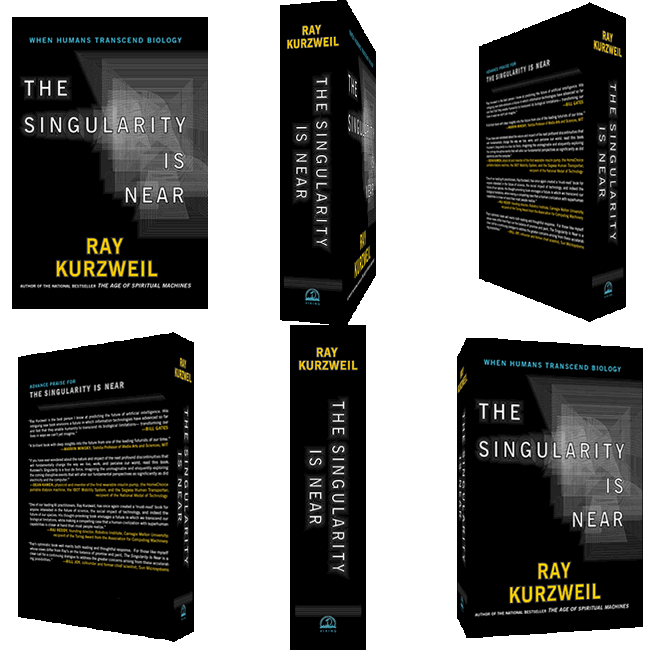
In this much-anticipated sequel to The Age of Spiritual Machines, Kurzweil presents the next stage of his compelling view of the future. The merging of humans and machines -- the Singularity -- will be "... a future period during which the pace of technological change will be so rapid, its impact so deep, that human life will be irreversibly transformed," he says.

We are in the very early stages of this transition, and within just a few decades, life as we know it will be completely different, Kurzweil explains. "Non-biological intelligence will match the range and subtlety of human intelligence. It will then soar past it because of the continuing acceleration of information-based technologies, as well as the ability of machines to instantly share their knowledge. By 2045, we'll get to a point where technical progress will be so fast that un-enhanced human intelligence will be unable to follow it."

That means we will reprogram our DNA, human aging and illness will be reversed, world hunger and pollution will be solved, and our bodies will be transformed by nanotechnology, so that, for example, we will eventually be able to augment and replace our biological organs and vastly extend our intelligence. Eventually, he concludes, we will increase the powers of our intelligenceUniverse.
by trillions of trillions of times and expand to rest of the


Sep 18, 2005

Wikipedia close to Top50

I remember telling some people recently that Wiki was the 70-sth most popular site on the net. Well, I was apparently using some outdated info (probably half a year old). I am happy to report we are the 53rd most popular site ATM. Or 49 on Global list. Alexa is bit confusing with different summaries and list (why can't I find Wiki on any other but the global list??).

For comparison:

Yahoo:1
MSN:2
Google: 3
eBay:5
Amazon:7
BBCOnline:10
Blogger: 33
Slashdot: 1,049
TheOnion: 2,639

One more thing I often say is that in a few years, Wiki will be as popular as Google. Comparison of 2 years (see graph below) is interesting: Google is of course much more popular, but Wiki is growing much faster. Google almost doubled its popularity - but Wiki popularity increased hundredfolds (see Wikipedia:Statistics for details). With some numbers one could fairly easy create a prediction. I may even do it sometime soon, for curiosity (and statistical excercise) sake. My 'eyeball Mark.I' estimate gives Wiki about 5 years to reach Google popularity. What's your call?

Sep 14, 2005

The four premises

Of the Good Technoutopian:

1) We are presently undergoing a (postindustrial) revolution in technology

2) In the postindustrial age, technological growth will be sustained (at least)

3) In the postindustrial age, technological growth will lead to the end of economic scarcity

4) The elimination of economic scarcity will lead to the elimination of every major social evil

Sounds good to me...

Sep 12, 2005

Flog of the Prokonsul

Long story short, as a part of one of my courses, I have started a second blog. You may want to check it at http://pioflog.blogspot.com/ (hyperlinks not working atm, blogger is having user interface issues again...).

Enjoy :)

Update: Hyperlinks working again.

Sep 3, 2005

Epic 2015

Interseting futurology flash movie. Enjoy few minutes of peering into the near future: EPIC 2015

Aug 28, 2005

Ethics of Capitalism

It takes a great man to see that evil is sometimes necessary. John Maynard Keynes, one of the most prominent economists, was apparently not enchanted with capitalism. Yet, he saw that we have no other choice. He wrote:

For at least another hundred years we must pretend to ourselves and to every one that fair is foul and foul is fair; for foul is useful and fair is not. Avarice and usury and precaution must be our gods for a little longer still.
For only they can lead us out of the tunnel of economic necessity into daylight. (JMK, CW, IX, pp.329, 331)

This rings very similar to my favourite quote by Winston Churchill:

Many forms of Government have been tried, and will be tried in this world of sin and woe. No one pretends that democracy is perfect or all-wise. Indeed, it has been said that democracy is the worst form of government except all those other forms that have been tried from time to time. Speech in the House of Commons (11 November 1947)

It is somewhat comforting to know that there are great people who can see the obvious. Neither democracy (or what passes for it today) nor capitalism are perfect. But for now, they are the best we have. And of course, this means there is a silver lining to all this: an implication that there is indeed something better, and as we slide faster and faster towards singularity, we get closer to the new, better world - with a fairer political and economic systems.

So, look forward to the future. I know I do.

And in the meantime, feel free to read this interesting article (
KEYNES AND THE ETHICS OF CAPITALISM by Robert Skidelsky).

Aug 27, 2005

Busy busy busy

I have been busy like I haven't been for a long time. And my net access is still fairly limited. So in case any of you have the time I don't, I'd like to point you to the Collected Driblets of Baen: A Frankly Promotional Endeavor... a page with many snippets of upcoming Baen's books. Enjoy!


Aug 15, 2005

Short status update

While I usually don't write about myself here, as I don't consider my own persona to be that interesting, there are times and places for exceptions - especially when I can use my own person to illustrate some truly interesting stuff.

So let me tell you a story now. I am not in Pittsburgh, where I will be doing the PhD at Uni of Pitt :) I will likely be researching history of democracy, impact of communications technology on it and likely some issues related to the political system of 'noble's democracy' of the Polish-Lithuanian Commonwealth. So, I am of course quite happy.

But this is not what I wanted to write about - this is simply a background info to what I really wanted to tell you about - my first impression with US. Which is extremly positive. Everybody I met here, and I mean literally everybody, has been very very friendly. Starting from two others PhD studends from my program which helped me find an appartment in less then 24h after I arrived here (Tim and Marvin - if you are reading this - tnx again!), through very helpful and wonderful secreatries at my department (of Sociology, if sb wonders), to some old black guy in the supermarket which after hearing that I have no discount card lent me his own... well, the list can go on. I admit I am highly impressed. Maybe I am on some kind of 'meet nice ppl spree', but really...for example when I wnet looking for a Greyhound bas station yesterday and asked for directions, four different people I asked were very helpful - not simply pointing 'go there', but giving very specific directions and one guy even escorting me for few minutes through some intercity maze making sure I won't get lost. After hearing the America is the center of the rat race and such, I have to admit I didn't expect to meet so many kind people almost everywhere.

So this is a short status update. Thumbs up America, and expect the next post when you see it...

Aug 6, 2005

What are you made of?

In a few years, this will be no longer a philosophical question. With DNA sequencing prices plummeting, the new age in medicine is approaching. Another milestone in the quest toward immortality... just as Ray predicted.

It's coming'...

Jul 31, 2005

Fantasy and sf in Poland, Part 1

Due to popular request (well, a request), here is the overview of sf and fantasy literature in Poland.

Stanisław Lem is perhaps the most famous of Polish sf authors. He has written some great books and imagined concepts like nanotechnology (prominent in his "Invincible" book) or virtual reality. I remember "Futurological congress" as the first book raising the question 'what is reality. It is quite similar to Dick's Ubik in this regard. Nonetheless my favourite Lem's book is "Fiasco" ("Failure"), a story of a an attempted contact between two space faring civilisations. It raises Drake's equation's question of "why are we alone in the universe", and is a nice description of a failed contact - no happy end here. "Golem XIV" is another one of my favourite, raising the question of what happens when AI becames sentient and eventually, more sentient then human - here Lem raises the issue of technological singularity. The book is written in a form of combined Golem thoughts print-outs and comments of suprvising scientists. Then there is "Lord's voice" - which is quite similiar to Sagan's Contact. Oh, and lets not forget the entire book ("Fictional vaccum") composed of nothing else but reviews of fictonal books :) Last, but not least, there is a fairly large series of what I call 'stories'. Those are books and antholgies whose heroes are either robots or the cosmonaut Ijon Tichy, and all are a cross between a child's bedtime story, a parody of something, and...well, it is difficult to describe. See wiki's entry on The Cyberiad for some more info and a specific example. I am not a great fan of those series of his works, but I know many who would disagree. It is a shame in his late years Lem have stopped writing books and instead writes newspapers essays against technological progress and prophetising civilisation destruction. A consensus among sf fans in Poland helds it that old age has finally cought up with him (he is 84 now...) and made him a little, well, senile...sad, to see such a great writer tumble. On the bright side, many of his works have been translated into English (and Czech and many other languages), so you can just go Amazon, grab some of Lem's Golden Age books and see how good a writer he once was for yourself :)

Now, Janusz Zajdel. He is much less known outside Poland, a shame - the Zajdel Award, the biggest Polish sf Prize (think Nebula) was not named after him by an accident. Majority of his books - all of them, now that I come to think of this - were 'distopias'. Wiki sais it as well as I could: His novels created the core of Polish social fiction and dystopias. In them, he envisions totalitarian states and collapsed societies. His heroes are desperately trying to find sense in world around them, sometimes (like in Cylinder van Troffa) they are outsiders from a different time or place, trying to adapt to the new environment. However, the main idea that is visible to any reader is to force the readership to compare their gloomy, hopeless sitation to what may happen in space environment if we transfer totalitarian ideas and habits into space worlds. Red Space Republics or Space Labour Camps, or both. See his article there for info on his specific books like Paradisia. If I were to compare him to some known Western author, I think Dick would be the closest. Perhaps it is good to think that Zajdel = Dick - drugs + communist regime experience. Or in other words, Dick had visions of living in utopias and distopias, and Zajdel lived in one.

That ends the pre-1989 section of Polish sf. There are a few more names I could mention, but the are definetly not famous, and quite forgotten even today. Well, ok, I will add one more: Snerg-Wiśniewski. I have yet to read his classic, the "Robot". But one book of his I have read I will remeber forever: "Według Łotra" ("According to the Bandit"). It is a story of a Messiah in dystopia, told by one of the two bandits who would be crucified with him, eventually turning into an Ubik-like questioning of what is real and what is not. If one likes Dick and Zajdel, then Snerg is another must read.

Sapkowski, now, Sapkowski is definetly a post-1989 success story... Without a doubt, he greated a great fanstay series. "Wiedźmin" - 'witcher', 'hexer' (word invented by Sapkowski) is a story of a superhuman fighter, Geralt. Sounds boring? Well...a cynical and intelligent superhuman figher, who belongs to the cast of monster-killers. Once essential to the survival of the humans in this word, he and the few remaining members of his caste are feared and hated by everybody, treated like scum - well, scum that can kill. Add to it a great world - a New World, where humans nearly drove other races (elves, dwarfs) to the extinction, the world were realpolitik and money rule the day, and where the 'dark empire' of Nilfgaard is preparing to conquest the small kingdoms of the north, brining progress, order and technology no matter wheter the 'northern barbarians' want it or not. And, if case you are wondering, Geralt doesn't give a XXX about big politics and such. However, it apprers some powerful people want to make him their pawn...well, the story is written beautifuly, the characters are great, the background world is amazing... In addition, Sapkowski can make one laugh - especially in the early Wiedzmin side-stories/mini novels, which are not so dark as the series that follows it. And yes, the story has ended after 5 books - Sapkowski wisely (IMHO) decided that enough is enough and attempting to turn his idea into 20+ series would kill it, so he envisioned a good end and ended the story where he wanted it.There is a RPG based on this world, a movie and a tv series (both of which unfortunately were done by total idiots who thought they could write better stories then Sapkowski and cut him out of the loop, with predictable results resulting in what I think is the worst fantasy movie ever (seriously, even TROMA couldn't have done it 'better'), and a computer game in-making. All in all, this is a great fantasy, one of the best I have read. I would call it at least as good as GRRMartins or Glen Cooks works, and much better then your average run-of-the-mill fantasy. I think he was translated into Czech, wasn't he, Martin?

Next time, I will tell you more about few other great Polish writers...

Jul 28, 2005

The Tolkien you don't know

Some months ago I wrote a post expressing my amazement on why almost none of the rich and great non-English literature was translated into English. I won't repeat myself, instead, I have some good news: where official publishing houses fear (?) to tred, fans step in, bringing you some high quality unofficial translations.

Here you can read part of the famous (at least in Eastern Europe) 'The Last Ringbearer' by Russian writer, Kiril Yeskov, a great Tolkien inspired book. We all know the story of Middleearth, of brave hobbits voyage and of the struggle alliance of men, elves and dwarfs against the evil empire of Mordor...right? But have you ever heard the phrase: "History is written by the victors"? What if the Tolkien story is just that, a cover up for the much different truth?

And here you can find links to another fantasy, this time a Japanese trilogy - Legend of Twelve Kingdoms (Junni Kokki).. Anime is fairly popular, but few people know that it is often based on novels. Usually, the proverb that 'a good novel makes a bad movie' is true. But apparently it does not hold true for Japan - they seem to make great anime based on great novels. Shame they are not translated.

Hope you like what you find. If so, why not lobby your publishing house to translate the books?

Say, Martin, if you are reading this, could you tell me about some native Czech and Slovakian writers?

Jul 26, 2005

World Wind vs Google Earth

Time to correct a few details from the last post. At present, the coverage offered via virtual globe software is not real time (it may be over a year old!) and not 'military grade' - i.e. at best, you can see a car, but not a person (1 pixel = 15 meters). On the bright side, it is still cool :) Now, for comparison of two of the most popular softs: World Wind and Google Earth (and yes, this time I have installed them and seen them myself :>).

Keeping it short: World Wind offers several types of maps, but kills the CPU (official bug promised to be fixed in some future release), has no hiqh quality coverage other then USA and eats drive space like mad. Google Earth is much smaller, faster and hdd-friendly, and offers some HQ maps of non-USA places, although they seem mostly limited to Western Europe. Both softs could do with better user interface and debugging. For example, World Wind can either show all names (city, dostricts, streets, etc.) or not at all. Google Earth has quite a few filters, but seems to have problems displaying important things like cities name, and its search function seems to work badly with non-US cities (actually, my searches for Katowice and Cracow/Kraków were directed to some strange places in US). There are quite a few other bugs: World Wind maps don't work well with axis change, creating terrible artifacts that seem to recreate themselves even after image refresh, and Google Earth interface can freeze sometimes. All things considered, all of the above seem more like a beta versions then any final release - but they are still mighty cool. I was unable to find my house in Katowice (Poland), but I could find my quarter and I am pretty certain I recongized some larger landmarks like the naerby airfield, lake or scyskraper. US coverage is beautiful, and you can find individual houses (hotels, universitites) easily - after half an hour learning the controls, I found both the university I will do my PhD (University of Pittsburgh) and hotel I will be staying for the few days looking for the appartment.

Here's hoping that high quality coverage for rest of the world will be availalble soon, and that real time super high quality coverage will not take more then few years. Anyway, I highly recommend downloading the above software and taking a look. If I had to chose, I'd say go with Google Earth first - it is smaller, faster and more user friendly. If you like it, give World Wind a try as well. Expect to lose a few hours either way :)

PS. Mars/Moon and other maps in making...

Jul 24, 2005

The world on your screen

Interesting. NASA created the 'World Wind' soft, free to download, that provides high resolution satellte scans of the entire world (screenshots). If you leave in US, you should have no problems finding your home. I will see if it will prove useful in finding me an appartment :) Which also reminds me of the 'privacy scare' some people are fond of: the malicious government is watching us from above! Bah. Now, everybody can be a Big Brother... there is nowhere to run :) Hopefully, some privacy freaks will now dig a dungeon and stop bothering the rest of us :)

Jul 22, 2005

Review of the Sarmatian Review

It is always a nice suprise to find an academic publication that is easily accessible through the web, and doesn't hide its publications behind some expensive scheme, usually out of reach of a normal student's budget. This is the case of the Sarmatian Review, a small (quaterly) but good quality publication dedicated to Central and Eastern Europe.

The web design is very simple, one can say 'primitive' (the covers are terrible), but it is functional. No javascript, no flash, no large graphics - just access to the articles, with a simple but functional search tool. One thing I'd like to see is some kind of comment/forum for discussion of various articles, but I am not suprised an academic publication is slow to adapt such 'public discussion' tools, but I hope it will happen soon. After all, the strenght of the Internet is not only that it allows such specialised sites to adress worldwide public, but that it allows easy two-way communication.

All things considered, I am pleasantly suprised whith quality free content of this site, especially considering how much troubles (and/or money/time) one has to go through to access most academic journals. Even with my economic MA I have much trouble understanding why they are so expensive. Sure, there is litte demand for them, but by putting such prohibitive prices in place, they are off-limits to most studends and casual readers. Perhaps its my wiki/open source POV, but I think it would be much more useful for everybody if all academic publications were free and easy to access, just ike the Sarmatian Review.

Jul 20, 2005

Looks like fun

I won't have time to play it myself, but perhaps one of you readers will and tell me if it was worth it: AdventureQuest - looks like a new generation of MUDs - that what I call progress :) Enjoy!

Jul 19, 2005

Some reading: 2 FAs to look at

Polish September Campaign just got featured on Wiki's Main Page, and History of Poland (1945-1989) is my newest and longest (so far) feature-quality article. Perhaps you will find them interesting.

Jul 7, 2005

Spam Poison

Nifty. Just follow the link below to learn how to kill the spam spiders.


And good riddance, spammer-d00des :)

Jun 23, 2005

The economic prediction

With my background in economics, I find The Economist predictions are usually right on spot. It's the only print magazine I read - if you don't, my advice is to get one and try to get hooked up. Oh, the current online edition is always free.

Still, the today's subject is not how good TE is, but what is it saying. And it's predicting a bubble
is about to burst on the housing market.


The worldwide rise in house prices is the biggest bubble in history. Prepare for the economic pain when it pops.

Soaring house prices have given a huge boost to the world economy. What happens when they drop?

In many countries the stockmarket bubble has been replaced by a property-price bubble. Sooner or later it will burst, says Pam Woodall, our economics editor.


You have been warned...

Jun 19, 2005

The Good Old Quard

When I was younger, I thought they were hilarious. I still think that now. The Quard Corners, 1995-1999 are a piece of history - mine, net and MTG (what's that? read the Corners to find out). I loved them, and they are still funny.

The QCs in today's post serve dual purposes: an illustration to two points. A good and a bad one.

Good one: the tool I used to find the Quard Corners, which I presumed lost few years ago when thedojo.com portal went down (now is a spam ad site) was the Internet Archive (aka the Wayback Machine). A very nifty tool to search for sites you presumed lost - give it a try. It may come in handy one day. The point is that even if you are looking for something far from serious, you may discover a tool useful for scientific purposes. I have already used it to get access to some articles I thought were gone.

Bad news is that Quard, while great in the past, seems to have lost 'the touch'. He has a site now, with a blog and thing...but it is no longer funny. Poor jokes and 3%#5-like obscenities aplenty. Point being this time - 'how the mighty have fallen'. There is funny and there is sad. If I ever start sounding like that, kill me on spot.

Tommorow is my 25th birthday. Here's wishing that Quard's regains his touch that made me once ROTFLOL.
 
Listed on BlogShares Creative Commons License
Voice of the Prokonsul by Piotr Konieczny is licensed under a Creative Commons Attribution 3.0 United States License.
.