May 16, 2005

Good riddance :)

Internet Explorer share slips below 90 percent


Better late then never. Honestly, how can web savvy people - using forums, blogs and such - still use such a backword, user unfriendly and unsafe product as IE is beyond me.

May 12, 2005

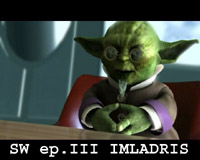
Star Wars III: The better take


85 mb - believe me, worth every bit of this. ROFTLOL.

When you get up from the floor, try


If you can still move, go for some other great production from STASZEK :)

And remember: STASZEK IS THE BEŚCIAK

May 9, 2005

KurzweilAI.net

Most of the time, Wiki and few foras like Baens Bar are enough to make my web-day. Still, from time to time one discovers a site that is so...nifty...that one has to add it to his fav websites (after all, they did find their way there like this in the first place). My new discovery is KurzweilAI.netTechnological Singularity. Yes, news - I have to admit that I signed for their weekly newsletter, which collects interesting news stories, and I don't regret it. I don't have to look for them anymore - they are arriving in my mail - news about nanotechnology being used in production, gene sequencing costs droping rapidly...all those cool things that say 'Singularity is a'comin'!'. Plus it has a bot. And graphs. And link maps. And a guide how to live for eternity. If it ain't nifty, then what is? - a nice collection of news about the


I will buy you a beer at Olympus Mons yet :)

May 8, 2005

How it all started...

While we are celebrating the end of the Second World War, it is good to remember how it all started...


German troops destroying a Polish border checkpoint, 1 September 1939. World War II begins.

Following the German-staged attack on September 1, 1939, at 04:40 hours, German forces invaded Poland's western, southern and northern borders. Polish armies, defending the long borders, were soon forced to withdraw east. After the mid-September Polish defeat in the Battle of Bzura, Germans gained undisputed initiative. Polish forces then begun a withdrawal south-east, following a plan that called for long defence in the Romanian bridgehead area, where the Polish forces were to await expected Western Allies counterattack and relief. On 17 September, 1939, the Soviet Red Army invaded the eastern regions of Poland. The Soviets were acting in co-operation with Nazi Germany, carrying out their part of the secret appendix of the Molotov-Ribbentrop Pact (the division of Europe into Nazi and Soviet spheres of influences). In view of the unexpected Soviet agression, Polish government and high command decided that the defence of the Romanian bridgehead was no longer feasible and ordered the evacuation of all troops to neutral Romania.

Testing 2

Testing comments...

Apr 24, 2005

And one, two, three...singularity here we come!

1950s:
"One conversation centered on the ever accelerating progress of technology and changes in the mode of human life, which gives the appearance of approaching some essential singularity in the history of the race beyond which human affairs, as we know them, could not continue." -- Stanislaw Ulam, May 1958, referring to a conversation with John von Neumann

In 1965, statistician I. J. Good described a concept even more similar to today's meaning of singularity, in that it included in it the advent of superhuman intelligence:

"Let an ultraintelligent machine be defined as a machine that can far surpass all the intellectual activities of any man however clever. Since the design of machines is one of these intellectual activities, an ultraintelligent machine could design even better machines; there would then unquestionably be an 'intelligence explosion,' and the intelligence of man would be left far behind. Thus the first ultraintelligent machine is the last invention that man need ever make."
1993: Vinge's essay "Technological Singularity" contains the oft-quoted statement that "Within thirty years, we will have the technological means to create superhuman intelligence. Shortly thereafter, the human era will be ended."

2001: n his essay, The Law of Accelerating Returns , Ray Kurzweil writes: An analysis of the history of technology shows that technological change is exponential, contrary to the common-sense "intuitive linear" view. So we won't experience 100 years of progress in the 21st century -- it will be more like 20,000 years of progress (at today's rate). The "returns," such as chip speed and cost-effectiveness, also increase exponentially. There's even exponential growth in the rate of exponential growth. Within a few decades, machine intelligence will surpass human intelligence, leading to The Singularity -- technological change so rapid and profound it represents a rupture in the fabric of human history. The implications include the merger of biological and nonbiological intelligence, immortal software-based humans, and ultra-high levels of intelligence that expand outward in the universe at the speed of light.


2005: So where are we now? Check the recent (April 23rd) New Scientist: Whatever happened to machines that think?
In the next few months, after being patiently nurtured for 22 years, an artificial brain called Cyc (pronounced "psych") will be put online for the world to interact with. And it's only going to get cleverer. Opening Cyc up to the masses is expected to accelerate the rate at which it learns, giving it access to the combined knowledge of millions of people around the globe as it hoovers up new facts from web pages, webcams and data entered manually by anyone who wants to contribute. Crucially, Cyc's creator says it has developed a human trait no other AI system has managed to imitate: common sense. "I believe we are heading towards a singularity and we will see it in less than 10 years," says Doug Lenat of Cycorp, the system's creator.

It is close. Every day, it gets closer. Today? Tommorow? Next decade? I don't know about you, but I *am* expecting to see Singularity during my lifetime...

Apr 18, 2005

A year in review OR a new mission statement

This entry I will do something I rarely do: I will write a little about myself. Please bear with me - at least if you want to know the reason for lack of updates over the past weeks and what is likely to happen next. If you are a causal - or first time - reader, I invite you to go throug archieve instead, as most of my entries are more interesting then this, and few lose their relevance.

It has been a year since I started this blog. A lot has happened since then. A year ago, I had just obtained my MA in Economy, I was torn between looking for job, looking for a doctorate and just 'living the life'. One of the reasons that made me start this blog was my desire to keep contact with other human beings, since I lost touch with majority of my student-day collegues. Another was because I believe I had something to share with you - something interestign along the lines of various reviews, ideas, links and such.

Now many of this has changed. I am pursuing a doctorate, which does take some of my time (and is likely to take even more with time) and I discovered an apparently better venue for my desire to contribute to others - meaning you - the Wikipedia. While this blog has received at best a little over 50 hits per months, my Wikipedia contributions, especially my eight (so far) Featured Articles, had been viewed by scores of thousands. I would like to take this moment to thank all of my readers - you, again - especially Jason C, the only person who more or less regulary commented on my posts, and therefore is the only person I can actually name and thank in person (I could try to make an educated guess based on some IPs, but if you want to remain anonymous, well, it is your choice :) ). You were the reason that kept me blogging, hoping to make your time visiting this site worthwile. But web gravitation - and simple common sense - made me spend more and more time on Wiki, were my contribution is simply much more valuable - instead of being of mild interest to few dozens of people, it is of use to many many more.

What I want to say, basically, is that barring any comments on your side, I will likely settle on blogging once per week or less. I simply don't think this is useful anymore - to me or you - compared with what I (and you) can do with our time on Wikipedia.

Feel free to drop here again. I will likely post, as always, various trivia and useful links that I think are important - or just *so* funny. Or anything you request. Just no so often as I used to.

Take care and visit my Wiki homepage to check on my most recent articles!

Apr 4, 2005

Something begins, something ends

It is nice to see something one helped to create grow. And no, I am not talking about Wiki this time. Check Worldcon blog entry on Games Research Association of Poland.

In other news. A great man has passed away. I am sure you know who I mean. But still, you may want to check His entry on Wiki. In Poland, I have seen many mourning flags and such. And I have heard - seen, read - that it is common in many other parts of the world. I wonder if any other person alive today could commend such loyality...or love? Truly, the Pope was the friend of us all.

Mar 27, 2005

One can wish...

...for more often updates, perhaps? Well, I guess not. Still, I have not abandoned the blog. Just that I am busy working on Wiki (and my doctoral studies seem to have finally picked a pace up...more on that later).

Central and Eastern Europe have been a site of much war and destruction over the last few hundred years. But in alternate history, this could have been different, for example, if one man dream would have became a reality:


In 1919 Józef Piłsudski envisioned a federation (the "Federation of Międzymorze"), a Polish-led confederation comprising Poland, Lithuania, Ukraine and other Central and East European countries now emerging out of the crumbling empires after the First World War. The new union would have had borders similar to those of the Polish-Lithuanian Commonwealth in the 15th–18th centuries; and it was to be a counterweight to, and restraint upon, any imperialist intentions of Russia or Germany. It might have made central Europe into a "Third Europe" invulnerable to Poland's historic antagonists, Germany and Russia.

It might have. It didn't, since it never happened. Soviets pulled all strings they could to prevent this. Western Allies feared that weakened Germany and Russia may not be able to pay First World War reparations, and that the balance of power in Europe would be offset too much by the newly independent countries. Lithuanians, Ukrainians and many other nations that were approached for entry into the Miedzymorze federation were afraid of any compromise limiting their own, dearly awaited independence, and in many cases had good reasons to be wary of Poland, as various border conflicts and even all-out wars divided their new, respective governments (especially the Polish-Lithuanian War, Polish-Ukrainian War and border conflicts between Poland and Czechoslovakia). Finally, many Polish politicians like Roman Dmowski were opposed to the idea of multi-cultural federation, prefering the creation of nationalistic, pure-ethinic Polish country. Eventually, Piłsudki's dream was lost in the aftermath of the Polish-Soviet War, and the alliance between Central and Eastern European countries was never formed. Less then two decades after Piłsudski first articulated the proposal, and five years after his death, all of the countries that so persistently guarded their independence were again swallowed by their neigbours - Germany and the Soviet Union.

One can only wonder what would our world look today if Piłsudski's dream became a reality. I can't help but think that for the war ravaged European countries this alternative world would be a better one...

Mar 18, 2005

Wikipedia Publishes 500,000th English Article

Press release:

The Wikimedia Foundation announced today the creation of the 500,000th article in the English-language Wikipedia, its project to create a free, multilingual, online encyclopedia. The article was about "Involuntary settlements in the Soviet Union (http://en.wikipedia.org/wiki/Involuntary_settlements_in_the_Soviet_Union)." Wikipedia is a comprehensive online reference that has won acclaim and awards (http://meta.wikimedia.org/wiki/Trophy_box) for its detailed coverage of current events and popular culture, its usability, and its community of contributors. It receives millions of visits each day.

Other recent additions to its English-language edition include hundreds of full-length songs (http://en.wikipedia.org/wiki/Wikipedia:Sound/list), almost a gigabyte of new images (http://commons.wikimedia.org/wiki/Main_Page), and subject-specific portals (http://en.wikipedia.org/wiki/Wikipedia:Wikiportal/Art).

Daniel Pink, author and WIRED Magazine columnist, recently described Wikipedia as "the self-organizing, self-repairing, hyperaddictive library of the future." BBC News calls it "One of the most reliably useful sources of information around, on or off-line," and Tim Berners-Lee, father of the Web, has called it "The Font of All Knowledge."

Wikipedia is the first and best-known project of the Wikimedia Foundation. It has spawned sister projects, including a dictionary, a library of textbooks, a compendium of quotations, and a news site. These projects are all run on the open source MediaWiki platform (http://wikipedia.sourceforge.net/).

Wikipedia is available free of charge and free of advertising from its website, en.wikipedia.org. Interested contributors can visit http://en.wikipedia.org/wiki/Wikipedia:Introduction to learn how to add to the encyclopedia. DVD versions of the encyclopedia are scheduled to be released in English, German (http://de.wikipedia.org/wiki/Wikipedia:Wikipedia-Distribution), and French, later this year.

Mar 15, 2005

Why ebooks are GOOD

It sounds bizarre, but giving something away for free is ahttp://www.blogger.com/img/gl.link.gif
insert link good way to make profit. A contradiction? No.

Read Building the , and don't forget to check the Ghostwheel!

Nice reading...and buying :D

Mar 1, 2005

Free Antivirus

It is worth following Sourceforge Projects of the Months. Each of them represents the best of open source community. And this month we got a real treat: a free antivirus, ClamWin:

ClamWin A Free Antivirus For Windows


ClamWin is a Free Antivirus for Microsoft Windows 98/Me/2000/XP/2003. It provides a graphical user interface to the Clam AntiVirus engine.

ClamWin Free Antivirus uses the GNU General Public License by the Free Software Foundation and is free (as in freedom) software. To find out more about GNU General Public License and what it entitles you to, please visit the following link: Philosophy of the GNU Project - Free Software Foundation.

ClamWin Free Antivirus comes with an easy installer and open source code at no cost. It features:
  • Scanning Scheduler;
  • Automatic Virus Database Updates. ClamAV team updates Virus Databases on a regular basis and almost immediately after a new virus/variant is out;
  • Standalone Virus Scanner;
  • Context Menu Integration to Microsoft Windows Explorer;
  • Addin to Microsoft Outlook.
The latest version of Clamwin Free Antivirus is 0.83 (click on this link for more information.

Gotta love open source. Now, where can I find good oo firewall?

Feb 25, 2005

Feb 23, 2005

Donate to Wiki

Imagine a world in which every person has free access
to the sum of all human knowledge. That's what we're doing.


And we need your help.

Fund drive goal: $75,000 (USD) $33,393.02 to go.

Feb 21, 2005

Good anime

I have discovered an interesting thing. More to the point, a new anime, definetly worth watching to all fans of good space combat.


Target destroyed!

Starship Operators is an anime (so far 4 eps have been released) about a single spaceship fighting a war after the main fleet has been destroyed and their country has surrendered. So far, every episode has a nice one on one battle, with a nice array of weapons (including asteroid throwing ship), decent tactics (how to spot a stealth ship or close to a long range ship) and character development. I had some doubts after the 1st episode if the story would hold, but after the 4 eps I am definetly hooked up and want more.


The crew

Btw, they finally managed to explain why we can hear sound in space...


Target spotted

Since the show is not licensed outside Japan, episodes can be downloaded from animesuki. Catch them when they are available!

Official site, probably nice...if you can read Japanese :D; some tech pics under mechanics section, character sections has character pics and bios.

Seaslug Team has pics and spoilers, be warned!
http://www.davidslife.com/anime/reviews/starship_operators_1.php (pics and review)

Your standard blurb on animesuki.

Feb 9, 2005

Late update

Almost a week with no updates - that is rare even for me. I was waiting for the replies to the quiz...got none :(

Well, no replies - I am not telling you the answer then. Over the next few days I'll be at Krakonsci-fi con, so expect few updates (please note...if you want more updates, all you gotta do is *ask* :D).

Quiz question nr 3: Who and when wrote the oldest alternative history?

 
Listed on BlogShares Creative Commons License
Voice of the Prokonsul by Piotr Konieczny is licensed under a Creative Commons Attribution 3.0 United States License.
.